
By Ogova Ondego
Published December 10, 2006
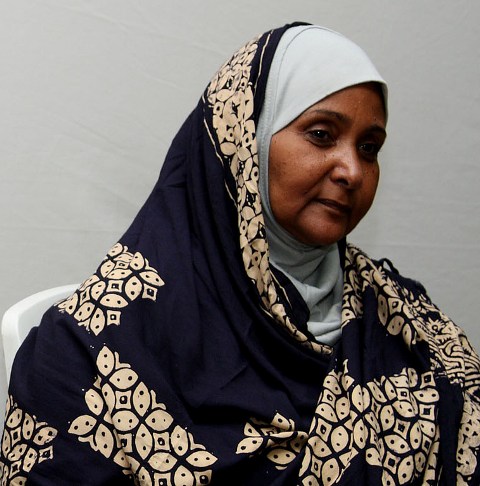
 Polio may have disabled her feet, making it difficult for her to walk unaided, but Sara Gadala Gubara is not just an award-winning international swimmer and ballet dancer but is also the first woman in the Sudan to have studied cinema. She speaks about her career, family, and gender politics in a largely conservative Islamic state.
Would you please introduce yourself and also tell us something about your work?
I am Sara Gadala Gubara, a Sudanese filmmaker who graduated from Cairo Academy of Art and Film Institute in 1984 in film animation and directing. I started working in 1985 with Sudan Television. I was in charge of animation film and so I made three to four short films in the old tradition of making animation, i.e. drawings and not using computer-generated graphics. Then I established my own studio in Sudan where I work as a photographer and director. I am also in charge of my father (veteran filmmaker Gadala Gubara who has since gone blind)’s studio. I am thinking of founding a film institute in Sudan as there is none there currently.
How many filmmakers does Sudan have?
Eleven. But only about five of these direct documentary films. Only my father Gadala Gubara, myself, Abderrhamane and Anuar Hashim make feature films.
So how many films have been made in the Sudan?
From the 1950s to 2004, Sudan had made only seven feature films.
What problems affect cinema in the Sudan?
Islamic Sharia law is impacting negatively on filmmaking while most people in filmmaking are not professionally-trained.
Does the government support filmmaking?
No. Television is vigorously and strictly censored but you can still get away with film. In such a setting, it is better not to be a professional.
How many television stations does Sudan have?
Three; one is based in Khartoum while two are national.
How many women make films in Sudan?
One, just me. It is difficult. One has to work day and night and not every family will agree to this.
How are you managing it yourself?
Because my family is different and understanding; my father encouraged me to make films.
How about your husband, is he as supportive of you as your father?
Actually my husband is a very good man; even before we married he knew I made films and that I had to work. We work in the same field; he is a film editor. He edits my films. We work in the studio as a family. All my kids studied different things but they work in the studio as well.
How and where did you meet your husband?
My husband and I met in Egypt where he was studying medicine while I studied cinema.
I note that you do not walk normally. What happened?
I was born with polio in my leg. Under ordinary circumstances I would have been rendered almost useless but my father helped me a lot and encouraged me to study cinema. I’m very famous in Sudan where I was an international swimming champion. If you are courageous enough you can do just about anything. I can’t walk normally with this kind of body but when I get in the water it is a different story. I can also dance ballet. I love the water and keep on training. I am the second international swimming champion all over the world. I held the record four times between 1975 and 1980. My father even made a film script on me called ‘Viva Sara’ that he sold in Italy where they made a film about me and my accomplishments. This encouraged me a lot as I feel my achievements are even greater than some people who are able-bodied. I am the second woman to have studied cinema in Sudan. My predecessor was half Sudanese and half Egyptian and so I am the first Sudanese woman to have pursued cinema.
How many films have you made?
Three feature films. One 15-minute animation, THE BEAUTIFUL FATMA, could pass for the Sudanese version of Cinderella. I made the second film on video. In all, I have made about 20 documentary films.
It is easier to make documentaries in the Sudan than feature films. I like working with beautiful girls so I work with my daughter, a beautiful actress. She is 20 years old and doing films now.
How does Islam enable or hinder cinema in the Sudan?
I don’t think Islam should be used as an excuse to undermine cinema. Iran is an Islamic country but they make good films that are known all over the world. We need the government to help people. If cinema is a good medium of communication as it is, governments should support it. I think we have to push the government to know our message in order to support us otherwise they can’t come to our aid.


