
By Ogova Ondego
Published April 22, 2014

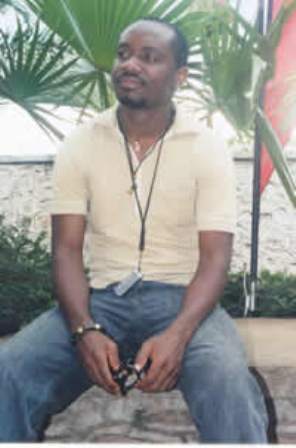
Petna Ndaliko Katondolo is arguably one of Eastern Africa’s leading experimental filmmakers though he detests his style being referred to as’experimental’. He speaks about his role as an artist and activist.
RELATED: Women Consolidate Their Supremacy in Eastern Africa’s Filmmaking Sector
Perhaps you could start by talking about your work; the films you have made and what they are about.
One of the films I made in 2003 is titled BURNT THEATRE. It is about the theatre that was burned down by a volcanic eruption in Goma, eastern Congo. I made this film to show that despite the hopelessness and suffering of the people reported on by the mass media, there was still hope in Goma. The media had focused the suffering to the exclusion of hope.
Sometime back, the French embassy in Uganda had wanted me to make a DVD on the culture of the Acholi of northern Uganda. I chose the metaphor of the calabash to represent African culture. Hence the birth of LAMOKAWANG.
I produce at least a film on the effects of globalisation every three months. I just made one in Busagali, Uganda, about a people thrown out of the island they have known as their home for as long as they have been alive.
I made TWAOMBA AMANI in eastern Congo with my sister who works with a women’s organisation in Goma. I got some footage of women demonstrating against rape from her. The women had gone to soldiers who are accused of sexually abusing them and dared them to rape them in public; some even removed their clothes.
Besides this footage I also got some musicians together to do a music video whose footage I used in TWAOMBA AMANI. This is not a film but a statement. The Congolese have for a long time been used to praising politicians. This has to change. Artists haven’t been playing their role well. If they do so now Congo will be transformed into a great nation whose citizens can be proud of.
The other film I have made is SEARCHING FOR DIGITAL SPIRIT. It was done in Belgium in an area called Matongo that is inhabited by Africans. The name is taken from a Kinshasa neighbourhood. This is an act of resistance. Here, some people take on the police who insist on arresting a young man without papers with shouts of: “This is Africa. You can’t arrest him. This film shows that Africans must not always say Yes to everything but must claim their rights. I made this film in 2004 while returning from Barcelona. Digital is one or zero, i.e. yes or no.
RELATED: Youthful Zimbabwean Filmmaker with a Golden Touch
 How many films have you made so far?
I can’t recall as many of these were commissioned by Non-Governmental Organisations.
How about you tracing your journey into filmmaking for us?
I began my work as a filmmaker by shooting weddings. However professionally, I have been making films for six years. I have also worked with Belgium-based Congolese filmmaker Balufu Bakupa-Kanyinda and Malian academic and filmmaker Manthia Diawara.
Have you faced any obstacles on this journey?
It is a paradox that it is easier to hold a gun than a camera in eastern Africa where the latter is considered a threat to authorities. I have been forced by military authorities in Goma to erase my footage three times. I have faced a similar situation in Uganda. This is the first challenge to filmmaking. The second challenge has been finance but then the digital technology is mitigating this. With 15,000 Euros, one can now make a good film.
What, exactly, would you say led you into filmmaking?
My journey into filmmaking was a deliberate move aimed at correcting the injustice done to Africa and Africans. I wanted to see positive black images on film. Blacks have always played bad roles on screen. I told mum I would make positive black images. I developed interest by drawing and painting.
RELATED: Nudity and Sex Introduced to Ghanaian Movies
I stopped going to school at Form Four equivalent but at that time art wasn’t anything you could live on. My parents gave me space for an art studio. As there was no film school in Goma, I studied theatre and did some training in television production for a year after which I did internship with a local TV station in north Kivu. I didn’t like TV and continued looking for a film school in Tanzania, Kenya and Uganda but got nothing. I had to study film online till recently when I got a scholarship in Amsterdam, Holland, to study as I work.
How long have you lived in Uganda?
I have been based in Kampala for seven years.

So how do you compare the status of art in eastern Congo with that of Uganda?
Art is well developed in Goma but there are fewer opportunities, everything being centred in Kinshasa. In Uganda, it is not so well developed but opportunities abound. But Congo should decentralize for its citizens to benefit. I’m not talking a federation now because of our history. Once we become one nation we could then go for that. But for now, let every region concentrate on its specialty: Kinshasa on music, Lubumbashi on painting, and eastern Congo on cinema. We should stop only looking at Kinshasa because of the injustice going on. Only artists based in Kinshasa are benefiting. Not only politicians can unite the country. Artists should also play their role in nation-building.
RELATED: Al Jazeera English Airs Orphans of the Sahara Documentaries
As a budding filmmaker, have you ever considered working with leading Congolese filmmakers like Deudone Mweze Ngagura and Bakupa-Kanyinda?
I thank Balufu Bakupa-Kanyinda for being my mentor. There is a saying among my people that “We did not climb on the shoulders of our elders to look at their toes.†We should look at the future. The elders have been telling stories. But I’m a digital person who should use this technology in telling stories. I must fit in today’s world. We have a role of participating in writing African stories in the tradition of Ngugi wa Thiong’o, Bob Marley, Patrice Lumumba, and Sembene Ousmane.
Cinema can help us in re-writing history. We are from an oral culture. Cinema speaks directly to our people. Americans and Europeans used cinema for propaganda purposes; to show they are great and unchallenged. But we don’t have to imitate them. No one is greater than another. I have learnt this from my elders: musicians, writers, and filmmakers.
I like cinema but not just for entertainment. Congolese musicians have done well in music but I can’t praise them. You can’t buy clothes for 9,000 Euros yet you don’t have a house and Congo is suffering while the ordinary person can’t even afford to feed on a dollar a day. Bob Marley was a great musician but he didn’t live lavishly. We should decolonise our minds as Ngugi wa Thiong’o says using cinema. I can’t go for simple stories in cinema. Coming from Africa, I have a responsibility to help develop Africa. I have to speak for my people regardless of style, format and quality of the work. That’s why I’m collecting any footage I can lay my hands on in Goma to preserve in an archive and enable people to tell our own stories. I am an activist and an artist. But I don’t want to be called an activist. As an activist, I don’t care about the rules of cinema as I do when I put on the hat of an artist.
 How do you describe yourself—an experimental filmmaker?
I hate to be referred to as experimental as it means one who doesn’t know what one’s doing; that one’s still trying to find a style. My films are not experimental. They are artistic works. When I showed them in France it was said their quality couldn’t be coming from Africa as if only young Europeans are the only ones who can make quality films. They therefore dubbed them experimental works.
LAMOKOWANG shows an Africa that is creating new ideas and images. But Westerners think we can’t understand certain styles of cinema; that we are emotional beings. If we make anything good it must be experimental, they say. This is why I don’t want my works to be called experimental. My works are either ˜artistic films or statements depending on whether I am donning the hat of an artist or activist.
RELATED: Ethiopia Unveils New Filmmaking Princess
What inspires you?
The driving force is my background. My dad was a pastor, grandpa a doctor, eldest and younger sisters humanitarians, while I am a filmmaker who is determined to make cinema a reality for Kenya, Uganda, Tanzania, Rwanda, Burundi and eastern Congo.
So what will you tackle in your next film?
My next film will be on Queen Nyabingi. Perhaps people are killing one another in Rwanda, Burundi, and Uganda because of being governed mainly by male presidents. Nyabingi was a queen in this region. I will re-enact her life in a modern way. The film will also touch on King Leopold of Belgium. People ask me why we are killing ourselves but I tell them you can’t judge people without knowing their past, their history. This film will show that problems could be plaguing our region because our goddess is no longer there. We’ve gone through difficulties and no one talks about it. We were traumatised by the Belgians.
 What style will you employ this time round?
The film will be a documentary feature. My sister, Pamela, is said to be the one disturbing the spirit of Nyabingi. She is supposed to inherit Nyabingi’s spirit.
How do you see film developing in Africa as evidenced by the Nigerian straight-to-video filmmaking model?
To me Nigerian film is not a success but only demonstrates that there is market for African cinema. We need people who can produce, direct and distribute film in Africa. Training is required for African film to get going.
We must look for ways of funding our own films without having to look to the West. Local businesspeople don’t believe we are good enough to make films. Some businesspeople in Congo asked me how much money I want from them in order to make films the Nigerian way for them to invest in film
You are involved with Baobab Connection and Yole Africa! What are these organisations you work with?
I co-founded Yole Africa! with my Dutch girlfriend who was researching on refugees in Uganda when she got to know that I used to run a refugee centre in Congo.
Yole Africa is working with Baobab Connection whose main activity is cultural exchange programme. The latter links youth and organises conferences in various countries. It holds online conferences.
Yole Africa! is a cry for Africa and uses art as therapy against trauma. We have a contemporary dance programme and hold an exhibition every year in Amsterdam.
RELATED: Lola Kenya Screen Confirms 2009 Festival Dates, Translates Films into German, French
This interview was first published on ArtMatters.Info on February 26, 2006. It is reproduced here following the World Bank’s 2014 listing of mineral-rich Congo-Kinshasa alongside India, China, Bangladesh and Nigeria as one of the five leading countries in the world where two thirds (1.2 billion people!) of the world’s poor live. In fact, the Congo is placed at the very bottom, its annual GDP per person being the smallest: 5). Congo-Kinshasa (US$5); 4). Nigeria (US$6); 3). Bangladesh (US$7); 2). China (US$13); 1). India (US$33).


