By Ogova Ondego
Published June 28, 2014

That members of the public could walk into a gallery and force the curator of an art exhibition to pull down a ‘painting’ they considered to be unsettling to society is an indictment of gate-keeping in the arts fraternity in Nairobi. It is a statement that though Kenya’s 2010 Constitution, hailed as one of the most liberal in the world so far, guarantees freedom of expression in the country, that freedom is to be exercised with responsibility; that it is no license to insult society or trample on institutions that have held the people together just for the fun of it.
RELATED: Kenya’s Lords of Art Exhibit Their Creativity
Get to the point, I hear you shout.
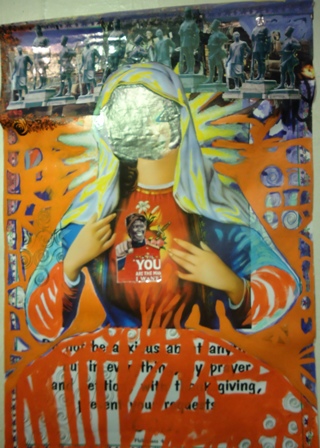 Yes, we are discussing Sex Retreat, a collage by Nairobi artist John Kamicha that was pulled down from a joint exhibition at Alliance Francaise in Nairobi; the art work in a show titled Sex and the City (April 3-27, 2014) showed a supposedly inebriated Jesus Christ surrounded by women of low virtue in various stages of abnormality. Another image in the provocative collage showed the man revered by Christians as their saviour crucified on a cross but still covered by one of his women in the foreground. Words like ‘Sinful’ and ‘Sex’ were written in the top right corner of the collage.
So what could have motivated the artist to create that collage? What was at stake? What had Jesus Christ done to warrant that depiction?
Some staff of Alliance Francaise who appeared agitated accused John Kamicha of abusing their intelligence.
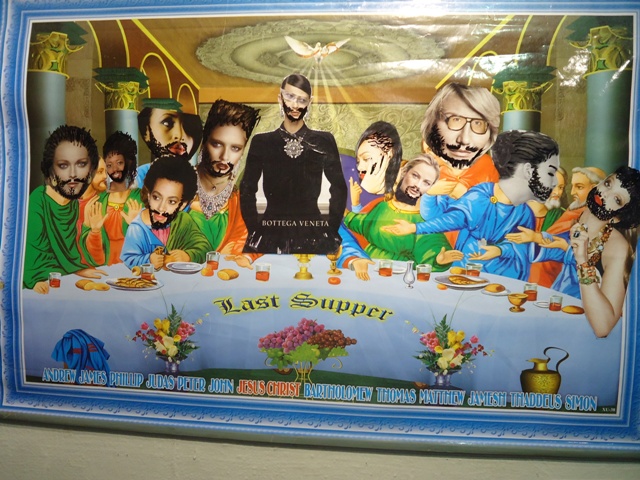
“The man simply takes posters or cuts colourful pages from wall calendars and then uses a marker pen to distort existing images and then calls it art for which he charges an arm and a leg. But what does he give to the Italians, Chinese and Koreans whose posters form the bulk of his ‘master works’?” posed an Alliancce Francaise worker. He illustrated his argument with Kamicha’s ‘Last Supper, a poster of men–supposedly Christ and his disciples the night before his crucifixion–whose faces John Kamicha has distorted with artificial beards and moustaches. Some of them look like transgender and transvestite beings. And the implied meaning is rather obvious, isn’t it?
RELATED: Africans Reproduce Classical European Art for Survival
The statement by the Alliance Francaise staffer forced me to re-examine the meaning of ‘collage’, a technique of composing a work of art by pasting on a single surface various materials not normally associated with one another, according to dictionary.com, and discovered that John Kamicha’s ‘Last Supper’ doesn’t really qualify as a ‘collage’. So what is it and why didn’t the curator of the exhibition consider this before accepting to include it in the exhibition? Did writers and reporters preview the exhibition before it opened? What was their verdict? Did they exercise their gate-keeping’ role responsibly or were they, too, found napping on the job? Was any copyright and intellectual property right infringed?
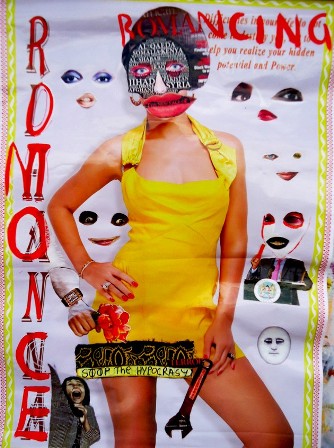
Another ‘collage’ of John Kamicha’s at the exhibition that was meant to examine the ‘sexual behaviour of Kenyans’, was ‘Hail Mary’. Once again, what did ‘Hail Mary’, ‘Last Supper’ and ‘Sex Retreat’ have to do with Sex and Nairobi City? Did they depict a contemporary issue, an issue in the news?
RELATED: Africa Arts Campus Explores Trends, Icons and Innovation in Creativity
This article, rather than attempt to analyse the works of Michael Soi and Thom Ogonga–who shared the platform with John Kamicha–restricts itself to the collages of John Kamicha. It contends that arts critics and arts curators are failing society in their ‘gate-keeping’ role.
 Till now, I have steered clear of the word ‘censorship’. I do not believe in censorship. I abhor censorship. Instead I worship (well, almost!) well grounded socialisation in the norms, taboos, values and traditions of a people. That socialisation leads to self-regulation.
Among the things that more than 80 per cent–have a look at the Kenya National Bureau of Statistics’ demography on faith–of Kenyans share is the ‘divinity’ of Jesus Christ. So, naturally, one should be careful on that front. One may attack clerics who go on ‘sex retreat’ without dragging Jesus of Nazareth into it. Fair enough? That is what self-regulation dictates.
Back to the point: a critic, like a curator and an artist, is expected to use history, logic and analysis to add value to creativity. Creativity springs from society. Society is a group of people with shared values, world view, traditions, norms and taboos that, together, form a people’s culture. It is this culture that informs our creativity. Creativity in all its manifestations: literature, cinema, painting, architecture, blogging, interaction, relationships, lifestyle!
A good critic, like a good curator and a good artist, must be in possession of qualities like vision, courage, honesty, objectivity, trustworthiness, truthfulness, right-mindedness, honour and fairness. Artists and gate-keepers should not stock controversy just for the sake of it. Their attempts at challenging the status quo should be well informed and for the betterment of society, not for antagonising it just for the sake of it!
I don’t see any inspiration, education, information or entertainment value in John Kamicha’s ‘Sex Retreat’ collage, do you?