
By Steve Biko Abuya and Japheth Ogila
Published July 31, 2014
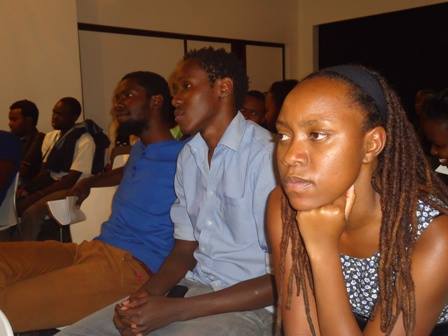
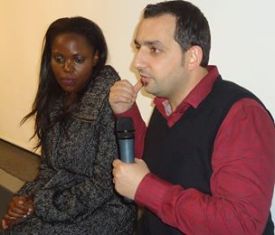
“In Kenya everybody is afraid to talk about sex. Mine is about using comedy as a vehicle to talk about it for it is not sinning but entertaining the audience,” said Alexandros Konstantaras, the director of ME, MY WIFE AND HER GURU film that was screened and discussed during the 78th monthly Lola Kenya Screen film forum (LKSff) on 30.07.2014 at Goethe-Institut in Nairobi.
RELATED: Film Provokes Debate on High Production Values at Monthly Film Forum
LKSff, that brings together players in the motion pictures sector with the aim of viewing, critiquing and adding value to movies as a socio-economic activity in eastern Africa, showed ME, MY WIFE AND HER GURU and THE BALL.
 The 50-minute ME, MY WIFE AND HER GURU is a comedy revolving around a rising young TV journalist who is entrapped under the spell of an opportunistic religious Master. Though the journalist is married, the Guru brainwashes her into leaving her matrimonial home to stay with him.
ME, MY WIFE AND HER GURU is set in Nairobi and covers the themes of hypocrisy, infidelity, crime and corruption.
 The film features actress Lizz Njagah (Angela the journalist), Tusker Project Fame (TPF) judge Ian Mbugua (Master or Guru), Kevin Onyango (smart thug) who features in the weekly TAHIDI HIGH programme on Nairobi’s Citizen TV, Millicent Wambui Mugadi (Esther) who is a former Big Brother Africa (BBA) contestant, and director Konstantaras (Steve), Angela’s husband.
RELATED: African Sports Films Tour Scotland Ahead of the Glasgow 2014 Commonwealth Games
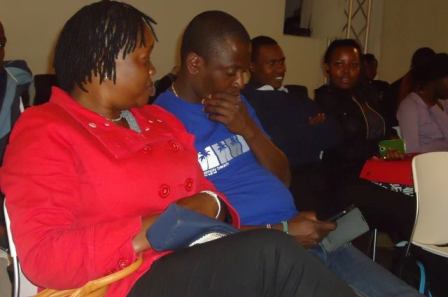
Produced in 2011 by Jitu Films, the drama evoked mixed reactions from the audience. Ian Saboke, who introduced himself as an actor and aspiring filmmaker praised what he described as the simplicity with which it delivers humour.
Speaking about the production, Konstantaras said that he and Njagah, his real life wife who also doubled up as co-producer, worked on the script for two days, a duration that some found wanting developing the blueprint of a serious film.
“Scripting should be given more feeling and detail for it is the blueprint of a production”, said Cajetan Boy who specializes in scripting and directing. He further advised the audience to thoroughly work on their scripts in order to avoid making half-baked productions.
RELATED: Ousmane Sembene: The Passing on of a Cinema Legend
 Konstantaras seems to like comedies with the ˜sex theme. His other productions, HOUSE OF LUNGULA (House of Sex in Nairobi Kiswahili slang) and FUNDI-MENTALS, also centre on sex themes that the filmmaker revealed to have been inspired by real life experiences which he satirises. He argued that even though Kenyans shy away from talking about bedroom affairs, they fill theatre halls to watch foreign bedroom farces.
 When ArtMatters.Info sought to know why Konstantaras maintains his cast members (Ian Mbugua, Lizz Njagah, Sarah Hassan and Gerald Langiri) from one production to another, he attributed this to their loyalty and outstanding talent.
Asked why he features ZAINABU RUDI NYUMBANI, a film by Jitu Films in ME, MY WIFE AND HER GURU among other productions, he said it was meant to ‘promote Kenyan movies which are not being promoted much’.
The 78th LKSff also screened THE BALL, a three-minute fictional children’s film set in Uganda and directed by Shams Bhanji. Fusing motion pictures and non-verbal communication, THE BALL is about a group of children who accidentally kick a ball that hits a transistor radio forcing its owner to cast a spell on the ball making it difficult for the children to kick it for it appears and disappears at his will. The film was screened as part of childfare to encourage local filmmakers to invest in children’s films.
 Unlike the other meetings that are usually held on the last Monday of the month, the 78th LKSff was held on a Wednesday to give room for the Muslims’ Eid-Mubarak celebrations that came earlier on in the week.
LKSff, the initiative of ComMattersKenya/ArtMatters.Info in collaboration with Goethe-Institut, runs every last Monday of the month to screen local short films and critique them with a view to encouraging filmmakers and exploring ways of integrating film production in Kenya and eastern Africa with other socio-cultural and economic sectors in order to come up with a vibrant film industry.


