By Dorcas Wambui Wanjau
Published September 3, 2014
 It looks like the Akamba of eastern Kenya are meant to have the thorns while the rest of their compatriots enjoy the scent, the colour and the feel of the roses.
At least that is the impression one gets from reading Thorns of Life, a novel by the prolific novelist, poet, essayist, actor and artist David G Maillu whose novel lists the various drought-induced famines, complete with Kikamba names, ”the famine of Kakuti, the famine of Yua ya Ndata, the famine of Nzalukye, as if to imply that the community is at the mercy of nature.
RELATED: Kenyan Writer David Maillu Goes Online, Turns Rural Home into Art Museum and Literary College
Described as Kenya’s Father of Pop Literature, Maillu uses an elderly widow called Kalunde to show how the Akamba live at the mercy of droughts, floods, famines and lack of basic infrastructure and how this plight shapes their worldview. Maillu appears to write with frankness, empathy and sympathy as he himself is from the community he is writing about.
Kalunde has more sorrows to share about her past young life; drought killed her mother; her husband and three children were carried away a flooded river and now she is struggling to save the crumbling marriage of her only son, Maweu, whose young wife, Nzivele, is getting wayward.
Published by Macmillan in 1998, Thorns of Life is a page turner. Maillu captures and keeps the attention and interest of the reader from the beginning to the end. Written as though it were from his own experience, the reader is unlikely to put down Thorns of Life from the moment one starts reading it; one’s mind travels to the setting of the story.
RELATED: Zimbabwean Writer Wins 12th Caine Prize Award for African Writing
 Maillu brings out issues of poverty induced by drought which Maweu refers to as ‘shame’. So poor are the people that the women either sell five or ten bananas, a few onions, and some green oranges and eat a few grains of boiled maize without any beans where such a meal was available.
In such a setting where death is a certainty, surviving to see the following day is driven by chance or luck. Here, people walk, looking for something to feed on, until they drop down with exhaustion and starvation. Others are killed or eaten by wild animals.
Rather than confront infidelity for what it is, Nzivele and Simon Mosi rationalize it away. For the former, ‘˜idleness’ is to blame while for the latter it is due to the impatience and poor hygiene of his wife.
RELATED: New Book on 2010 FIFA World Cup Presents South Africa as a Land of Contradictions
Maillu uses a descriptive and vivid language to capture the imagination of the reader: “The red brick shops looked more red today, like open wounds” to express how old the poor state the shops and to capture how ‘under-developed’ the place is; and “Three women passed them hurriedly, barefoot’. ¦They carried with them rather unpleasant smell..To take a bath weekly was for anyone living in this area a luxury” to capture the state of waterlessness in the drought-ravaged region.
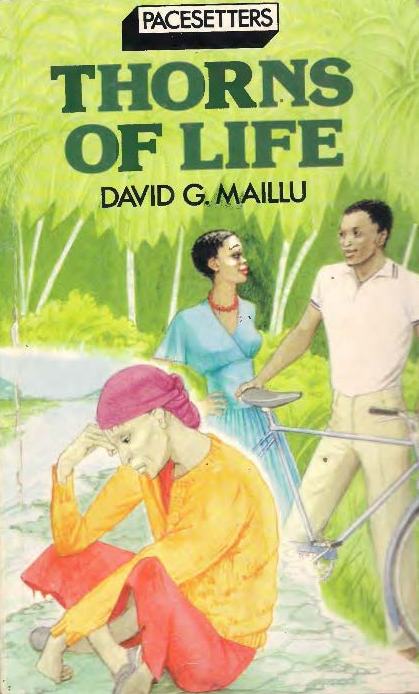
The cover of Thorns of Life is designed attractively to captures attention. The picture of an old woman–you can tell that from the visible wrinkles on her face–wears the look of a person who is dead with worry. It is placed against the picture of a younger woman and an equally younger man who seem to be interested in each other. There is even the status symbol of a bicycle thrown in the mix!
RELATED: How Nelson Mandela and Thabo Mbeki’s ANC Betrayed South Africans