By Fred Mbogo
Published November 10, 2014
[showmyads]
 A play that forces Kenyans to pose and reflect on historical questions, many of which have been conveniently swept under the carpet by the establishment but which occasionally show their ugly elements, is running in Nairobi till November 16, 2014.
Kaggia, the play written by teacher John Sibi-Okumu and performed by Phoenix Players under the direction of Nick Njache, is about the thorny issue of land, seeking answers to the question: “Where did all the land go?”
John Sibi-Okumu may be the name to look for if your interest is to dig into that murky past that is Kenya’s history through art.
RELATED: Thespians Turn Big Newspaper Stories into Humourous Drama
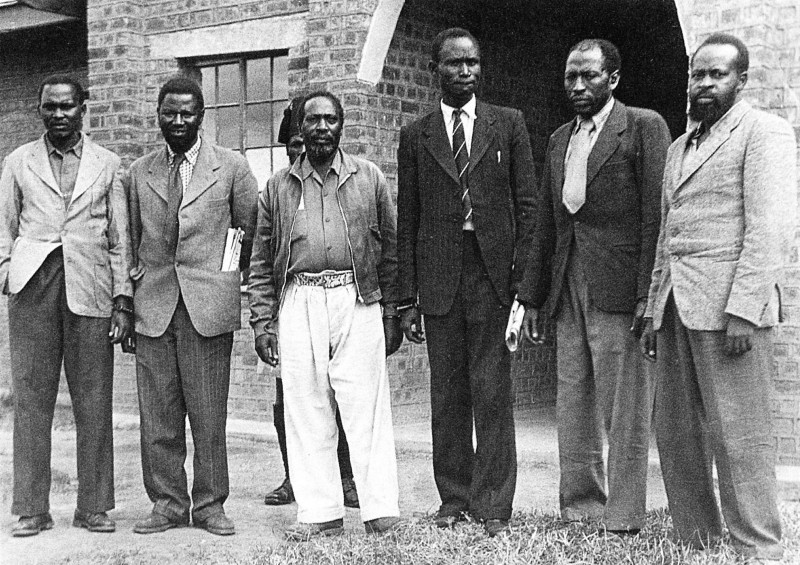
Sibi-Okumu is the playwright who has written such mind-engaging works as Meetings, Minister Karibu, and Role Play that have all been performed by Phoenix Players at Nairobi’s Professional Centre. Like Kaggia that is based on the life of Bildad Kaggia, one of Kenya’s six heroes–Jomo Kenyatta, Fred Kubai, Paul Ngei, Achieng Oneko, Kung’u Karumba–who were jailed for seven years in Kapenguria by the British colonial government on the accusation of leading a proscribed movement known as Mau Mau, these plays narrate the uncomfortable aspects of a past that more often than not is glossed over. The ‘traditional’, needful idea is to present a simplistic and ultimately acceptable history where heroes are embodied in the person of Kenya’s first president Jomo Kenyatta, and respectable elders personified by his successor, Daniel Toroitich arap Moi. In these narratives, there is a simplistic acceptance of Wangari Maathai as a heroine who ultimately wins the globally-recognised Nobel Prize for Peace but there is no mention of the characters that she struggled against towards her victory! The uncomfortable parts are swept under the carpet lest they upset the preferred narrative. One need only know that Wangari Maathai is awarded the Nobel for being good.
RELATED: Why African Artists Prefer Illegal Immigrant Status in the West to that of Freedom at Home
It is refreshing therefore, that John Sibi-Okumu’s Kaggia becomes this necessary play that sheds light on a past that is quickly being conveniently forgotten. The play is based on the life and times of Bildad Kaggia who in many ways has been a thorn in the flesh, first as a freedom fighter then as a politician with a conscience, to the powers-that-be. That Kaggia refuses to settle comfortably as part of the ruling class and instead becomes a voice for the people; arguing against greed, pointing out filth in the form of corruption, embarrassingly reminding President Kenyatta and his cronies of the reasons freedom was being fought for and generally being a nuisance to those that want to cheat the citizenry by sweetening history, is what the play shares.
The play, which opened to the public on October 31 and runs through November 16, 2014, is a clever fusion of imaginations from the minds of two screenwriters–Stacey (played by Yriimo Mwaura) and Xan (Bruce Makau)–”seekis to tell the story of Kaggia and flashbacks that give the audience a feel of the freedom fighter’s engaging personality, if not spirit. Kaggia is eloquently brought to life by Harry Ebale, an actor who over the years has acted in one play after another at Phoenix Players. He succeeds in showing how what seem to be mundane acts can actually be read as magical acts of resistance. The Kaggia played by Ebale is one that reads newspapers, and old books, for pleasure, and speaks in simple and fatherly ways to Njeri, his daughter. He treats Wambui, his wife played by Lydia Gitachu, to retellings that capture with playfulness the romance, through music and dance, which the couple once had. The suggestion of how he spends his time at his posho mill, gives the audience glimpses of the simple life that he leads; holding court with villagers discussing ordinary problems.
These simple acts are a rejection of another life; the life of privilege, where one behaves as an entitled member of an elite group who must lord it over his subjects. Indeed, the play’s key line is in the form of a question from President Kenyatta: “Kaggia, what have you done for yourself?”
The playwright gets it right by depicting Kaggia as a man who has refused to be seduced by capitalist comforts. Instead, Kaggia is seen here as seeking to serve his people. He wishes not to enrich himself. He simply states that his quest is to serve his people and not to take advantage of them and cheat them into building him a castle.
 As already stated, Kaggia is a member of the venerated Kapenguria six who were arrested, tried and jailed by the colonial government which thought them part, if not masterminds, of the Mau Mau. Kenya got its independence after their release from prison over seven years later. They became part of the leadership as cabinet ministers with Kenyatta as President. So, they were then “The New Bwanasâ€, to borrow a line from Sam Soko’s play aired on BBC in 2013. All should have been rosy but along the way, Kaggia was disillusioned. The ideals for which they fought for independence had been betrayed. Greed, the acquisition of property at all costs, came to be honoured by the ‘new bwanas’.
RELATED: Kikuyu Theatre Explosion in Kenya
Sibi-Okumu’s depiction of Kaggia in his element ‘performing’ the simplest of acts, therefore, entices us to re-imagine the place of the leader in national politics. For it is in denying oneself the pleasures of ‘lordship’ that a servant of the people shows his solidarity with the causes of the ordinary.
Harry Ebale’s facial expressions, body movement, and hand gestures play within that idea, suggesting that Kaggia did not want to be part of a thieving leadership; he, indeed, is the conscience of a people. He reminds the audience of the ideals that they should hunger for; selflessness, love for fellow human beings, and service for the greater good. The alternative is selfishness, cut-throat competition that breeds violence, and a culture that suffocates values related to justice, truth and common decency.
The play speaks to a present where strife based on historical injustice is making Kenyans very nervous as violence in parts of the Rift Valley and Coast regions get pronounced. Sibi-Okumu’s effort, therefore, is brave in as far as confronting issues that are best left undisturbed is concerned.
RELATED: Disorganisation costs Kenyan Thespians Dearly