
By Bamuturaki Musinguzi
Published November 20, 2014
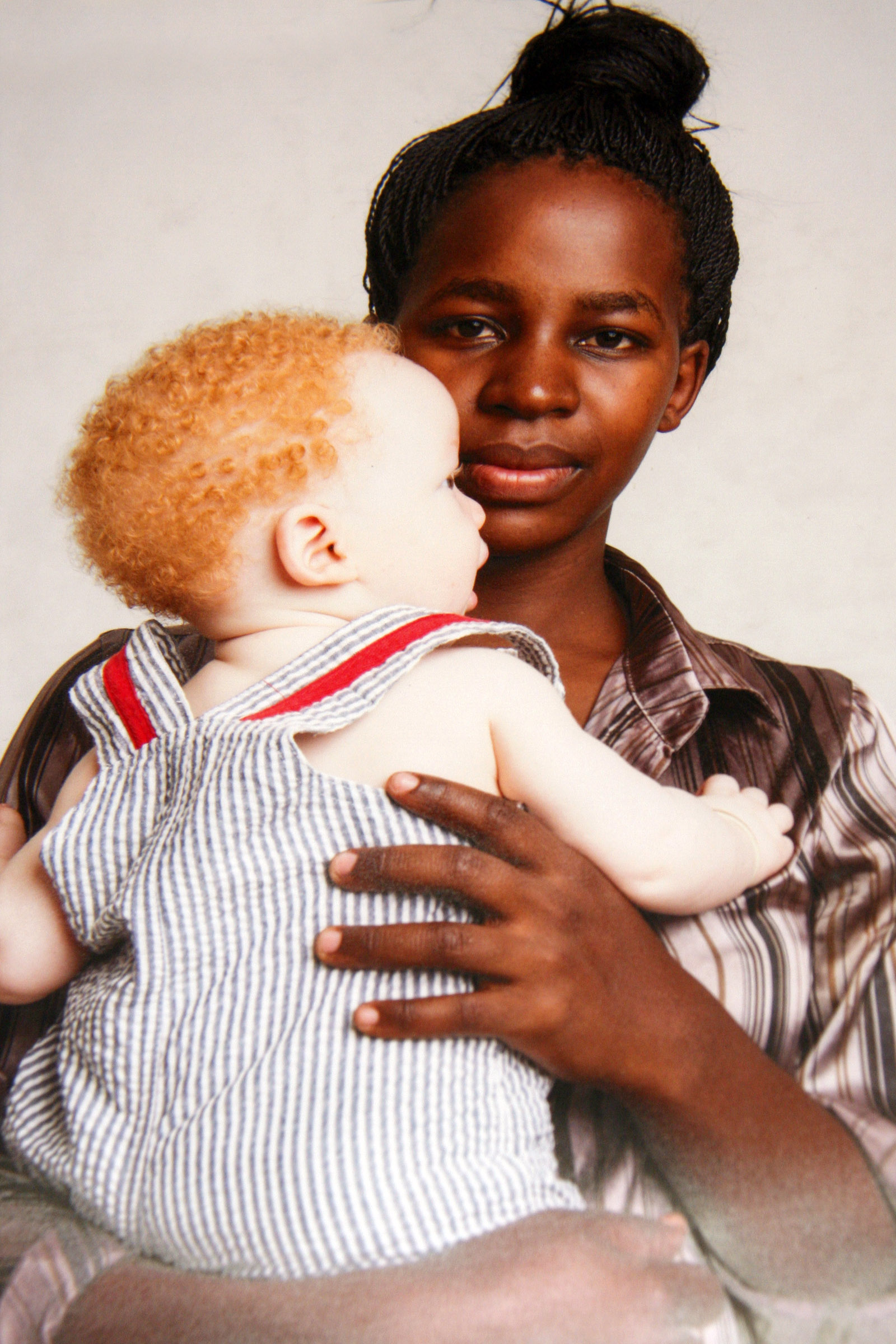
 Though albinos in Uganda have not been killed for their body parts as happens in Tanzania, they are still ostracised as outcasts by society.
This ostracisation is the main focus of a photo exhibition by Ugandan photographer Papa Shabani that he showed at the 7th Bayimba International Festival of the Arts held at the National Theatre in Kampala that ran September 19 – 21, 2014.
The exhibition captured the daily lives of albinos of various backgrounds, telling the positive side of living with albinism.
RELATED: Uganda Press Photo Award 2014 Winners Announced
The African Albino Foundation Uganda (AAFU) estimates the population of albinos in Uganda to be between 3,000 and 5, 000.
“People fear to talk about albinism in Uganda. These people are just like us, it is just that they have a different skin complexion,†Shabani told ArtMatters.Info.
Shabani said his albinism project was a work in progress as he continues to looks for the funds with which to use in focusing on the whole of Uganda.
“This form of advocacy is critical, for in order to have a voice on the domestic and regional stage, the challenges of albinism in Uganda must be documented and their particular case defined and addressed,†he said.
RELATED: Attack on Albinos in East Africa Linked to Nollywood Home Videos
Shabani, a recent graduate from the Faculty of Industrial and Fine Arts at Makerere University in Kampala, employs photography and film, graffiti, graphics, fashion and water colour painting in his creativity.
One of his albino pictures won the third place in the Portrait category in the 2014 Uganda Press Photo Award competition. He had earlier won the Second Prize in the Sports category plus Honourable Mentions in the Daily Life and Portrait categories in the 2013 Uganda Press Photo Award competition.
Shabani has exhibited in several group exhibitions in Kampala and his work has been featured on websites and blogs around the world.
This year’s Bayimba festival had more than 80 performances, productions and festival spaces that brought visitors closer to music, dance, theatre, film, fashion, and visual arts from established and up-and-coming local and international artists.
The local musicians that performed were Kaz Kasozi and his Sugarcane Band, Sandra, Sifa Kelele, Angela Kalule, Zawuka Band, Haruna Mubiru and Madoxx Ssematimba, among others.
The Kadongo-Kamu greats, Misuseera Ssegamwenge, Matia Kakumirizi and Hadija Namale did not miss out.
Sarabi Band from Kenya graced the festival as well as Chrispin (Rwanda), Nehoreka (Zimbabwe), SMADJ (Tunisia) and CAB (Cameroon, Algeria, Brazilian), among others.
RELATED: Al Jazeera English Exposes Who is Behind the Murder of Albinos in Tanzania
Local contemporary and hip-hop dances were performed by Restless Feet, La Baila Clinic, Street Dance Force, Miracle Saints and Dream House Uganda.
Stand-up comedy was by FourSum, The Punchliners and Abazeeyi be Bama.
In their play titled “Najjanani†(Who did I Come With) the Zubairi Family theatre group depict a corrupt and run-down health system in Uganda where patients are dying as a result of lack of specialists and negligence.
The setting is at a fictitious national referral hospital, where the medical superintendent is proposing that all patients to pay for the services but some doctors are resisting because the majority of the patients are poor and cannot afford. The superintendent’s argument is that with more income he will be able to pay the health workers higher salaries.
At the same time the superintendent is selling the drugs or taking them to his various clinics around town. The lower cadres pretend to be doctors and extort money from the poor patients.
The notorious mortuary assistant will not give you the remains of your loved one without you offering him a bribe, and he removes expensive clothes, jewelry and watches from dead women and takes them to his unsuspecting wife.
The superintendent murders those that are resisting his proposed changes at the hospital or attempt to stop his stealing of government drugs. He is also killed at the end of the play over disagreements in the illegal dealings.
The Santuri Safari DJs presented their unique sounds. Santuri Safari is a concept seeking to engage stakeholders (like radio, performing and producer DJs) in developing musical products with a strong East African identity, emphasising new music, fusion projects, remixes and edits to enhance and eventually replace the dominating mainstream foreign music played on radios and in clubs.
RELATED: Nairobi’s Public Court Over-rules Gate-keepers, Pulls down Offensive Artwork
The Santuri Safari DJs worked with Ugandan traditional musicians and sounds fusing them with electronic sounds that they presented every night of the three-day festival.
The Santuri Safari DJs also worked with German musician Jonas Hummel on “My Radio, My Voice,†a concept that makes music and instruments from old electronic devices.


