By Ogova Ondego
Published December 31, 2021
 That major infrastructure like roads, railways, airports and sea ports across Africa are developed by foreigners is indisputable; that the situation can be corrected by replacing Humanities with Sciences in the curriculum of local universities is debatable. Dominica Dipio, Professor of Literature and Film at Kampala (Uganda)-based Makerere University, argues that holistic development must have at its heart the arts as well as the sciences.
RELATED: Lack of Education and Mismatched Skills Hinder Africa’s Development
This, coming from the lead investigator in Research Innovation Fund (RIF), a US$8 million project for scholars at Makerere University aimed at sustaining work that drives the development agenda of Uganda, is no frivolous contention.
RIF, that was established in 2019, brings together storytellers, scriptwriters, actors, musicians and engineers to adapt and animate African folktales to provide local content for schools and television stations.
RELATED: Poor Sports Performer Writes World Class Novel
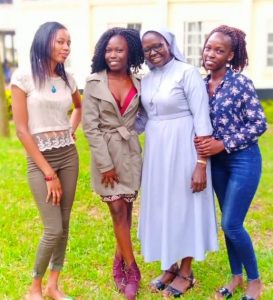 Rather than focusing on STEM (Science, Technology, Engineering and Mathematics) subjects, Prof Dipio says, RIF encompasses both STEM and Humanities.
“There is no doubt that STEM is crucial to the goal of creating a self-sufficient and thriving Uganda,” she says. “But in a truly cultured society STEM and Humanities should not be separated. Whereas STEM represents the shell/structure/body of development, Humanities are development’s gel/software/soul. Even Albert Einstein, one of the most famous scientists of the modern era, insisted that ‘all religions, art, and sciences are branches of the same tree’.”
RELATED: Why African Investors Need to Venture into the Flexible Workspace Industry
Just as her research in Humanities is augmented by her work with technology, she argues, “the best STEM scholars I know draw upon their excellent writing and storytelling skills of Humanities to convey the importance and urgency of their research to audiences. The mutually-dependent relationship between the two disciplines is important. If STEM trains people to quite literally build our country, Humanities infuse those structures with values and ethics.”
Prof Dipio argues that ‘teaching students Humanities means they will emerge as both productive, technically proficient workers and as thoughtful citizens’.
RELATED: Top African Business Entrepreneurs Announced for Awards
 That among the policymakers who have in the past called for universities to close down their Humanities offerings entirely in favour of an almost exclusive focus on Science and Technology have been William Ruto (Kenya’s then Minister for Higher Education) and Yoweri Museveni (Uganda’s President) may be an indication that governments not only have low regard for Humanities but that they are unlikely to support these subjects.
Little wonder then, that the role of training and equipping scholars in Humanities across Africa has been left to foreign funding agencies such as the African Humanities Programme (AHP) and the Cambridge Africa Fellowship for Research Excellence from which Prof Dipio and hundreds of scholars all over Africa have drawn support to pursue research in the humanities.
“In 2009 I was among the first scholars of the African Humanities Program (AHP) that is funded by Carnegie and the American Council of Learned Society,” Prof Dipio says. “After the AHP fellowship, I have won other research grants like the Fulbright, the Cambridge Africa Programme for Research Excellence, and currently, the Research Innovation Fund, a multi-disciplinary project that brings together colleagues in Humanities and STEM and that is funded by the Government of Uganda through Makerere University.”
RELATED: Black African Countries Analyse Their National Learning Assessment Systems
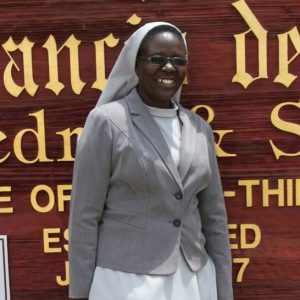 Prof Dipio says she integrates STEM in her practice as a filmmaker.
As “I had never been interested in fields that involved numbers, graphs, maps, and calculations—I wanted literature, languages, history, religion, the fine and performing arts in university. I did not yet have a sense that the subjects I was most passionate about were at the core of the humanities—I just knew that they centered around creativity, expression, and narrative,” Dipio says. “But as I worked through my bachelor’s and master’s degrees at Makerere University, and then my PhD at the Pontifical Gregorian University in Rome, I began to realize that even though my research was centered on the humanities, it was dependent on components of STEM (science, technology, engineering, and mathematics) — and most especially on the technical medium of film, which today I use to document oral histories, engage rural communities in conversation, and convey my findings to audiences.”
Dominica Dipio, a Missionary Sister of Mary Mother of the Church (MSMMC), is Professor of Literature and Film at Kampala (Uganda)-based Makerere University. She holds Bachelor’s (Education), Master’s (Literature) and Doctoral (Women in African Cinema) degrees.