
By Ogova Ondego
Published February 17, 2025
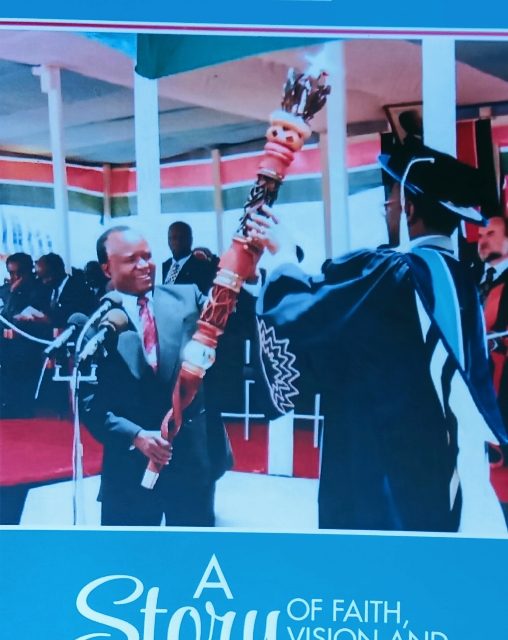
 Daystar University: A Story of Faith, Vision and Leadership is the inspiring story of a young US American Christian missionary couple to Africa whose desire and vision to see Africans communicate the Gospel of Jesus Christ effectively gave birth to a university whose influence on the art and science of Communication, Journalism, Public Relations and Culture reverberates around the world.
In just 372 pages, this book covers a history spanning 72 years through an engaging simple narrative style. The story begins in 1952 with Donald Kendall Smith and his wife Faye Gladys travelling to South Africa as missionary educators. They teach at a missionary school, found a magazine that is read across black Africa and relocate to Zimbabwe where, together with South Africa-based Lesotho-born Salzwedel Ernest Motsoko Pheko, set up Daystar Publications to ‘develop Christian literature and train Africans to write for their people in their own languages’. Under newly registered Daystar Communications the Smiths shift focus from publishing to research and training and begin the International Institute of Christian Communication (IICC) as the training arm of Daystar Communications. A while later they transfer Daystar Communications to Nairobi in Kenya where it becomes Daystar University College and then Daystar University.
RELATED: Determination, Hard Work and Prayer Build Kenya’s First Interdenominational Christian University
 The book gets rather controversial when it lists three other couples alongside The Smiths and the Phekos as founders of Daystar University. It is unclear how people like Dr Stephen Talitwala (executive director of Daystar Communications in 1979, principal of Daystar University College from 1984, vice-chancellor of Daystar University from 1994), James Mageria (Chairman of Daystar Communication’s Afro-Asian Board from 1976, Chair of Daystar University College’s Governing Council from 1984, and Chair of Daystar Company Limited from 1994) and James Kamunge (Chair of Daystar University College Governing Council from 1988 and Chancellor of Daystar University from 1994) – who were invited to share in the vision and work of the Smiths and Pheko could be described as founders of Daystar. If that isn’t an attempt at falsification of history then one doesn’t know what is.
RELATED: Evangelist of the Written-Word Exits the Stage
 And by the way, could the writers, editors and the publisher of this book explain why Godfrey Nguru, the first academic dean in 1985, deputy principal in 1984, deputy vice-chancellor in 1994 and vice-chancellor in 2005 whose immense influence on the curriculum of Daystar University cannot be wished away is not listed among the founders of Daystar University? James Kamunge, who joined Daystar in 1988 is listed as a founder while Dr Nguru who was hired in 1985 isn’t.
Holder of a master’s degree with specialisation in education administration and planning and curriculum planning and development and a doctorate in education, Dr Nguru expanded the undergraduate degree curriculum from the single communication specialisation in 1984 to five other concentrations (business administration and management, bible, education, community development and business administration accounting by 1990. When he was hired as vice-chancellor in 2004, Nguru introduced doctoral studies in communication, master of theology in African Christianity, two postgraduate diplomas in education and in child development, and nine bachelor’s and two diploma programmes.
Though excluding Prof Nguru from the list of founding families, the book pays tribute to him saying Daystar prospered under the education expert it says ‘used his strengths in human relations to keep staff motivated and the donor community engaged’.
RELATED: Alarm as Literate Kenyans Slide into Illiteracy
 The reader is likely to feel that writers Hellen Maleche, Bernice Gachegu, Rose Ngara-Muraya, Kamau Ng’ang’a, Allan Bukusi, Lilian Ogolla, Laban Ayiro, Faith Nguru, Muturi Wachira, Bernard Boyo, Michael Bowen, Mwaniki Mageria, Phyllis Mutua, Paul Mbutu, Mueni Nyokabi-Kahumbura and Samuel Muriithi have glossed over history by not giving the Institute of Christian Ministries and Training (ICMT) the prominence it deserves for its applied research and training from which churches and para-church organisations benefited and established Daystar as a credible institution before its Afro-Asian Board that had been set up in 1976 chose to put emphasis on bachelor’s degree training and thus made the board of trustees in US America that had supported Daystar Publications and Daystar Communications since 1967 choose to part ways with the institution in 1982 as they felt Daystar was abandoning the original mission and vision.
Granted, the writers have chosen to focus on the institute (later faculty) of academic studies in their narrative and not ICMT that aligned with the original vision of Daystar, i.e equipping Africans with the requisite skills for effective communication of the gospel among Africans.
RELATED: How Pop Culture Drives Black Women to Skin-Bleaching
 “From the onset, Daystar’s primary mission was to serve the church. It offered training targeting churches and church-related ministries to help improve Christian leadership. However, in mid 1990s, it shifted its focus to academics after the charter was granted in 1994” and became “academic oriented,” the book says in a section titled Cross-Cutting Matters.
As if to account for the almost forgotten place and role of ICMT in the quest for academics, the book says ICMT was mainstreamed within the academic division and courses run through it merged with sister departments in the faculty of academic studies. ICMT’s research unit merged with the academic division to form Department of Research, Publications and Consultancy (RPC) to ‘ensure better utilisation of staff, increase efficiency and bring income at market rates. ICMT became CMT but was reestablished as ICMT in 2009. It was renamed Institute of Leadership and Professional Development (ILPD) in 2013 and then renamed Daystar Leadership and Professional Development Institute (DLPDI) in 2014 and currently offers six-month certificate programmes, professional courses and short courses.’
RELATED: How to Rescue Africa from Political and Economic Misery
 Though the book says Daystar went through a crisis that tested its financial, spiritual, moral, social and leadership strength in 2017 and 2018 that saw it send Dr Timothy Wachira, its third vice-chancellor on a six-moth compulsory leave in 2017 before dismissing him in 2018, it doesn’t say anything about the unrest that saw students on Athi River campus go on strike in 2002/2003 during the tenure of Prof Talitwala, the founding vice-chancellor.
It also doesn’t say how or why Daystar, an interdenominational Christian university chartered ‘to provide Christian-based higher education, training and research for the expansion of God’s kingdom in the world’ and ‘to provide broad biblically based education programmes that will develop men and women to serve in a variety of supportive and leadership roles in the African church and society through … to help equip the church to effectively serve the society in which it exists’ opened its admission to non-Christian students.
RELATED: Why Kenya’s Education System Must Change and Keep Changing
 During the crisis that led to the dismissal of VC Wachira, a task force headed by Prof Henry Moses Thairu who later became Chairman of the Governing Council, had drafted a raft of recommendations that were adopted by Daystar Company trustees and ushered in what is known as the New Dawn from 2019.
Consequently, healing and reconciliation sessions for stakeholders aimed at letting ‘go of past hurts’ and fostering the ‘spirit of forgiveness and reconciliation’ were held under the new governing council and Prof Laban Peter Ayiro, Dr Timothy Wachira’s successor.
Though the founders, governing council members and all previous vice-chancellors are reported to have attended the healing and reconciliation meetings, nowhere in the book is there any indication that Dr Timothy Wachira participated in the events.
RELATED: Buy This Hope-Inspiring Kenyan eBook Online
 The writers of Daystar University: A Story of Faith, Vision and Leadership also fail readers when they say James Kamunge was awarded an honorary degree by Egerton University without specifying which sort of degree as they do when they say Daystar awarded Mageria and Talitwala an honorary Doctor of Laws (Honoris Causa) in 2008 and 2019, respectively. What was so difficult in calling up Kamunge or Egerton University to confirm which honorary degree had been awarded in recognition of Kamunge’s ‘exemplary performance as a public servant and for his contribution to the education sector’ in order to add value to a project as important as this book that documents the history of Daystar University?


