

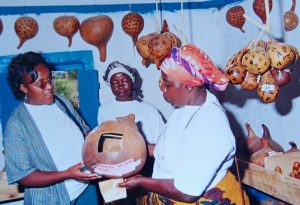
 As Westernisation gallops across Africa, it is eroding indigenous knowledge and culture and breeding chaos and anarchy. In Kitui, however, the local Kamba are fighting back. They just will not let their material culture attached to the bottle gourd (Lagenaria siceraria) locally known as kitete disappear. And their weapon, reports OGOVA ONDEGO, is art.
Hawafrica Women Artists and International Plant Genetic Resources Institute (IPGRI) have come to their assistance after they realised that the perennial seed shortage, declining crop diversity and food scarcity in the arid Kitui villages is a result of the reduced availability of kitete.
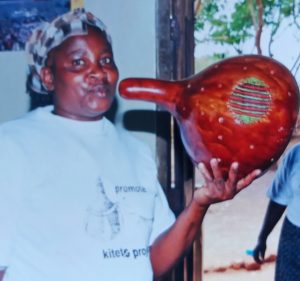
The use of a particular Kitete is determined by its size, shape and age. While the small ones with narrow necks are used as snuff and medicine containers, the small round ones with spotted surfaces are used as food when fresh. Very large Kitete are made into milk, porridge, and water containers with their long and narrow counterparts being split into halves and used as serving spoons. Kitete is also used for brewing traditional beer, attracting bees for honey-production, protecting chicks against predators, winnowing trays and plates.
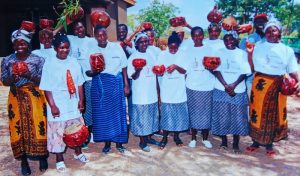
They can also be used as house decorations and for storing spells and medicine by medicinemen! To preserve the Kamba knowledge for economic, environmental, cultural and bio-cultural value, Hawafrica teamed up with Kyanika Adult Women Group and IPGRI to popularise the gourd through art at seminars, workshops, and baraza (public meetings). Consequently Kyanika, which began as an adult literacy class 12 years ago is not only churning out attractive baskets, bowls, lampshades, beauty ornaments, and chick protectors through calabash mosaic but are also earning a living from their hitherto endangered Kitete.
RELATED: Quest for Comforts of Heritage
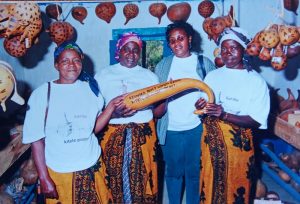 They have also become conservationists and will in February attend an indigenous people’s conference in Malaysia to showcase their knowledge alongside Eskimos, Aborigines, Maasai and other indigenous people of the world.
Using cement, glue and an alluring brown colour, the group is turning gourds into eye-catching items of art for domestic and commercial consumption.Their focus is set on the export market.
Hawafrica has also taught them screen printing techniques. That they are making T-shirts in a village without any machinery or electricity is something that baffles their mind.
RELATED: Kikuyu Theatre Explodes on Kenyan Stage
 Meanwhile Hawafrica whose aim is to identify and nurture artistic talent in women, is popularising banana fibre mosaic in Meru District through Caroline Njeri who is imparting the knowledge on street children of the eastern Kenya town. To an untrained eye, Njeri’s work, mainly wildlife and landscapes, looks like paintings or photographs.
But Njeri’s is a slow and painstaking job calling for lots of patience. “You have to study fibres carefully as you are working with naturally occuring shapes and colours,” says the 21-year-old Njeri. “Banana fibre mosaic is more than merely cutting fibres and mounting them on manilla paper. You have to capture both the image and the mood of the scenes you want to depict using the natural texture and colour of the fibre whose types and quality are determined by seasons.
RELATED: Ghost Intervenes as Kenyan Thespians Fight
 One has to be patient in this work.” Njeri starts by carefully identifying and selecting the fibres she requires. She then removes their top and back layers with a knife while they are still wet. She then has to decide whether to dry them using the sun or the iron box. “I prefer sun-drying to ironing because,” she says, “the attractive green fades when the fibre is ironed.” Once she has the fibres that best capture her pictures, Njeri uses wood glue to mount them. Using any other glue distorts the colour of the fibre and does not last as long as with wood glue, she explains.
Njeri, who completed Form Four at Murathankari Secondary School in 1999, studied neither art nor craft.
“I just picked this from my father with whom I worked before I met Hawafrica,” she says.
Their work on Kenyan wildlife, landscapes, and lifestyle pulled crowds at the national Museums of Kenya and Kenyatta University Culture Week in August and September, respectively


