
By Ogova Ondego
Published June 7, 2007
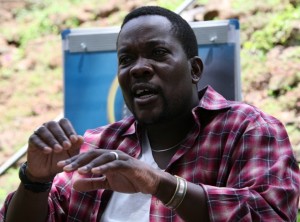 Never has any locally-produced film been screened to rave media reviews in Kenyan cinemas for weeks on end as has MALOONED, a 100-minute feature film set in a 15th floor toilet in a Nairobi skyscraper. Released on April 27, 2007, Malooned has screened to more than 2000 viewers in four cinemas in Nairobi, one in Mombasa and is set to show in Kisumu. OGOVA ONDEGO speaks to Bob Nyanja, the director of Malooned.
How long did it take to prepare, make and release MALOONED?
It took four months. We started writing out the concept outline on January 3, 2007. By the end of March we were on the 6th and final draft which we used to shoot the film.
How did you come by the idea to make this film?
On that day in Jan, I took my computer to be fixed in a building in Westlands, Nairobi. The technicians there told me the story of a university don who got stuck in one of the toilets on the eighth floor of the building and had to call home for rescue.He was rescued two hours later. On my drive back home the idea began to grow and I wrote out the story and shared it with colleagues before I called up my friend Mark Mutahi who turned my story into a screen play.
 Why have you used the name ‘MALOONED’? What does it mean?
It is a corruption of ‘marooned’, as to be marooned on an island. The word in the middle spells ‘loo’, a toilet. So watch out you don’t get malooned in a toilet next time.
RELATED: Meet Uganda’s Prolific but Little Known Filmmaker
Since its premiere on April 27, 2007, where has MALOONED been screened?
Two weeks at Nu-Metro’s Prestige cinema, one week at 20th Century, and two weeks at Kenya Cinema in Nairobi. It also ran for three days at Nyali Cinemax in Mombasa.
Please provide a break down of the number of people who have seen MALOONED so far.
So far, we have had over two thousand people; about 20 percent of these at Nu-Metro and 75 percent at Fox Theatres.
 Do you consider MALOONED a ‘commercial’ or ‘festival’ film?
For me it’s more commercial, though it fits into the festival mould because of its quirky concept.
How different is MALOONED from typical Kenyan NGO-funded productions?
Very different. We had the freedom to do the film the way we wanted; no obligation to pass a particular message. We just told our story the way we wanted to.
How did you raise the funds for making MALOONED?
 Savings from our production business over the last four years.
Please name what you consider to be the FIVE BIGGEST Challenges facing the audiovisual media sector in Kenya today.
Funds, no one yet sees film as a business.
Broadcast sector disinterest in growing independent production, there is no commissioning of productions to independent producers by broadcasters who prefer to do everything in-house.
Ridiculously cheap international programming that is available to our broadcast stations and lack of facilities to film. We had to build the set in a conference auditorium because the three available studios were out of reach; the one at Kenya Broadcasting Corporation was too expensive for us, the Film Studios one was booked, and the Kenya Institute of Mass Communications one was also busy.
Equipment, especially lighting, is supplied by one source only. It is still too expensive to get the right lighting crew and lights.
RELATED: Sudanese filmmaker wins lifetime achievement award
What solutions would you propose to counter the challenges you have named above?
We just bulldoze, keep working round each of the problems and demonstrate we are serious.
Why have you used virtually unknown cast and crew in your production?
Fresh talent for a fresh story is welcome; no baggage from other film projects.
What message do you pass through your film?
Reconciliation: let’s get out of our prejudiced toilets and work as nation. By talking, we will discover we like one another even more than we know!
 How do you propose to distribute MALOONED?
We shall sell broadcast rights to TV stations, sell on DVD…still working out other details.
Having been in the audiovisual media sector for a long time producing mainly commercials and corporate documentaries, would you say MALOONED is the best demonstration of your capability?
I have done this for nine years. It is definitely a reflection of what I have learnt over that time but not what I believe we are capable of. The inhibitions notwithstanding, this is what we can do with the limited resources we have. But we have bigger and better arsenal in store.
What are some of the productions you have worked on and in what capacity?
Equator, a Russian military comedy (locations manager, 2006); The Peace Wells documentary on engendering reconciliation among feuding Maasai pastoralists, 2006, director); Ethiopia’s Dream, a World Food Programme documentary to commemorate two decades after the 1984 famine that ravished Ethiopia, 2005, director); ICT Revolution documentary on Rwanda, 2005, producer/director); The Last Breakthrough, a 26-episode Chinese TV series, 2004, production manager); Project Daddy straight-to- video feature film, 2004, producer); Dangerous Affair straight-to-video feature film, 2003, line producer); Tomb Raider II, 2002, assistant director); Survivor III reality TV series, 2000, logistics manager); and Nowhere in Africa feature film,2001, locations manager).
Your film has received what could be considered generous ‘if not flattering’ coverage from the Press in Kenya. How do you explain this?
Generous I don’t know but flattering I don’t think. If the Press said what is contrary to the majority of the people who watch the film I would consider it generous and flattering but I have personally talked to the audiences, because I attended as many of the public screenings as possible and the response is amazing. I think the Press has been conservative. And most of all, I have talked with my peers who are the harshest of judges who have congratulated me. I have received so many positive short text messages from people saying I have set the bar for them. So there you go. I figure. the story resonates well with the audience.
Is filmmaking in Kenya easier now than, say 1990, that a film commission has been in place since 2005?
Filmmaking is easier now but not because of the establishment of the Kenya Film Commission but due to other factors. Equipment, for instance, has become cheaper and accessible. Digital Video and now High Definition Video format that we shot and edited this film from, has a fantastic look. So we don’t have to wait to raise money for filming and processing the film. More technical crew has come on board. Post production equipment is also not costing US$70,999. With US$8,000 or less you can have a pretty supped up edit bay.
How much did you put in this film in terms of good will or support in kind, and in cash?
For cash, we forked out more than Sh3.5 million (about US$50000) and in good will another 3.5 million. My value on the film is Sh7million (US$100000).
This is a colossal sum in Kenya; how much of this do you expect to get back from the film?
Even if MALOONED does not bring in much, it will open doors for me and other filmmakers.
If you had it to do over again, what changes would you make to MALOONED and what would you retain?
I would have wanted to cover more angles. I would have wanted to perfect the effects. I would have wished in a nut shell for one more week in shooting the film.
Let�s talk about the artistic part of the film. It is unbelievable for a woman who was all set on marriage to casually dismiss the relationship just because she couldn’t make it for the wedding due to reasons beyond her control as Di does in the film, don’t you think so?
Not if you are in an abusive relationship and you discover that you are basically desperate to get hitched before hitting 30. I think we should talk to women to find out if Di is credible or not.
When Luther tries to attract attention in order to be rescued from the toilet only leads to the flooding of the bathroom just as his attempts to charge his cellphone battery backfires as the room is plunged into pitch darkness due to short circuiting.
How does a water-flooded, dark bathroom suddenly dry up and gets well lit miraculously as happens in the film?
How does a park suddenly appear in the toilet, how does a dinner set suddenly show up?
It is film language.
But the flooding and lack of light were not merely artistic devices like the dinner set in the lavatory.
I wish we could put a time clock, but I think for the most part people understood these sequences.
RELATED: Ugandan Film Festival Trains Journalists in Arts and Cultural Issues
What are your academic credentials in audiovisual media?
I hold a Master of Arts degree in film and video production from Bob Jones University, South Carolina, USA.
What factors have shaped your private and professional life?
I spent a long time at university; two and a half years longer than normal. I did three years of undergraduate (BA) and three other years of postgraduate (MA) work in literature at University of Nairobi before I left for a Master of Fine Arts degree in film and video production for a further two and a half years in the United States. This adds up to seven and a half years of study.
I studied literature and practised theatre arts over all my five years at University of Nairobi.
I have a strong Christian foundation and I believe in the African spirit of love and care for the big family that is our nation. I believe that we are the best story-tellers in the world and that Hollywood stole our formulae of story telling and we need to get it back and unleash our own stories to the world.


