By Fred Mbogo
Published July 4, 2013
 Some 50 years after Kenya’s political independence from Britain in 1963, this eastern African country of 40 million is still unsure whether to consider Mau Mau, the band of men and women who fought the British over the alienation of their land and labour around Mount Kenya region, heroes. This is even more problematic in the wake of Britain’s 2013 expression of regret over the brutal manner in which it dealt with these land fighters drawn mainly from the Gikuyu, Embu and Meru communities.
With the out of court award of reparations to a group of about 5,228 former fighters, questions have popped up as to who, exactly, the Mau Mau were. Any old man of over 80, it is feared, could claim to be Mau Mau, if only to get a share of the Sh2.6 Billion compensation negotiated for the former warriors by the Government of Kenya.
The problem seems to be that the Mau Mau uprising escapes the narrow categorisation of fighters and liberators versus collaborators, loyalists, homeguards or betrayers.
While some homeguards worked for the enemy whose military machine they secretly sabotaged by leaking important information to the Mau Mau fighters in the forests, others were Christians who could have been averse to the tactics employed by the Mau Mau, especially with regard to the murky oathing ceremonies that were held to swear allegiance to the cause to fight over their land. These Christians may have been with the Mau Mau in spirit but were wary of the devilish approaches favoured by these seemingly unruly band of men and so didn’t openly identify with them; could they be considered Mau Mau? Could the betrayers who worked for the British administration but leaked information, food and/or arms to the fighters in the forests without being identified as members of Mau Mau be considered Mau Mau? How about the Mau Mau fighters who may have, under torture, revealed the secrets of their organisation to the colonialists? Do they deserve compensation?
 In an attempt to deal with the many contradictions of Mau Mau, writers, filmmakers, journalists, musicians, academics, and fashion designers are trying to unravel the mystery through what is starting to look like the emergence of what could be referred to as a Mau Mau cultural industry. There is a constant return to the anxiety associated with the State of Emergency (1952-1956) in Kenya in all the works coming out of this ‘Mau Mau Cultural Industry.
Dreams in a Time of War, the childhood memoir of Ngugi wa Thiong’o–Kenya’s best known literary mind and academic–published in 2010, gives details of people being executed, members of the same family fighting for or against the Mau Mau, family ties being broken, ‘betrayers’ being brutally assaulted or murdered, religion becoming the tool for the expression of identity, and so on. Many of Ngugi wa Thiong’o’s works capture this hopelessness in which anarchy could breed. In Secret Lives and Other Stories, Ngugi wa Thiong’o has a part of six stories capturing mental states that are hanging in between finding meaning in a hollow world wrought by brutal murder, bloody violence, and betrayal and almost religious and existential questions: why are we here?
Sam Kahiga’s Dedan Kimathi: The Real Story is a most illuminating documentary novel on the almost mythical figure of Mau Mau Field Marshal Dedan Kimathi. It presents mental pictures of the forests from which the Mau Mau launched attack on the colonialists and their perceived collaborators. The novel brings out perspectives on the revered Kimathi including his dalliance with women in a time of war. It proposes that there are numerous people who were involved in the war on either side that cannot be accounted for. Opportunists on both ends are exposed as are betrayers. But the lost fighters are an interesting feature in the work. Where did they go? Who are they? What are their names? These problems in the context of the promise to erect a monument in Kenya for those tortured and brutalised by the colonialists are rather disturbing.
 Dedan Kimathi’s name has birthed a number of theatrical works. The enigmatic personality of the fighter who was executed and buried in a secret grave in 1956 attracts imaginable dramatic images. Kenneth Watene created a play called Dedan Kimathi before Micere Mugo and Ngugi Wa Thiong’o wrote their own, The Trial of Dedan Kimathi. Their attempts were to celebrate what they perceived as the heroic deeds of Kimathi and his Mau Mau fighters in the forests.
From late July 2013 The Theatre Company, based in Nairobi, will be staging Looking for Dedan, based on the idea of the difficulty of capturing the exact narrative of Kimathi- if indeed his remains are buried in an unknown grave, for example. It is directed by Simon Oyatsi and written by Keith Pearson.
Perhaps the most audacious attempt at capturing the idea of Mau Mau, its spirit and meaning is in the film project, Muigwithania (Reconciliation), written and directed by Kenya-based Indian national, Amit Tyagi.
In Muigwithania, an injured Mau Mau General and his accomplice running away from colonial soldiers, come into a village in search of refuge. They seek to hide in an Indian man’s shop. The uneasy inter-racial relationships surface here, but the Indian man finds it in himself to help out. Everything works by the end of the film but the tension that lurks throughout combines a myriad experiences that touch on inter-racial identities during the State of Emergency; white, black and Indian. Privilege based on colour is exposed here. The Indian man is able to assist the Mau Mau General and his soldier only because as an Indian he is not under as much spotlight as his black countrymen. The film suggests then that there are many who fought on the side of the Mau Mau but who may not fit the profile of the dreadlocked, unruly looking Kikuyu man, an image popularly circulated in official communications from the colonial government.
But how this foggy identity has been repackaged by later day artists to suggest how an indefatigable spirit can be used to rouse liberation in present day harsh economic conditions is also of interest.
 Ukoo Fulani Mau Mau is a hip hop group based in Mombasa. It styles its music around a suggested Mau Mau-nessso that what comes packaged in its lyrics is a supposed fight against all forms of subjugation. One of its albums titled Kilio cha Haki (Cry for Justice) attempts to portray injustice as a vice that should be fought against. But in the lyrics of Ukoo Fulani Mau Mau there is a celebration of some masculine prowess that is being egged on to bring down barriers created by a system that seems intent at drowning hopes of a people. In the same hip hop line is the Mau Mau University clothing line that plies within a quest to fashion clothing with a hip hop urban touch.
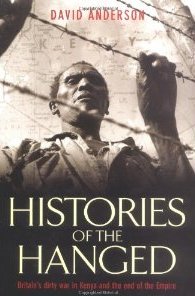
Academics are struggling to define Mau Mau through a multitude of texts. Lately the most circulated of these include David Anderson’s Histories of the Hanged: Britain’s Dirty War in Kenya and the End of an Empire and Caroline Elkin’s Britain’s Gulag: The End of an Empire in Kenya. These books are interested in the atrocities committed in the brutal exchange between the Mau Mau and the colonialists.
Anderson’s makes for a harrowing read that can never be accomplished in a few sittings; one has to torture oneself through the recaptured images of brutality. The described and narrated brutal scenes and images cut across both the Mau Mau fighting and recruitment tactics and the repressive attempts of the British. Ultimately, though, it is the British with all their might that are depicted as dealing so harshly with a group that was armed only with rudimentary weapons.
“Collective punishments were readily dished out against communities thought to be in league with Mau Mau, normally taking the form of livestock seizures or market closures. The most punitive measure of all was surely villagization; ¦the compulsory resettlement of people from their scattered ridge-top farms, into centralized, regulated villages situated at key points along the busier roads bore a striking resemblance to the British campaign in South Africa during the Boer war to control Afrikaner women and children…[and] was ˜the master stroke in defeating Mau Mau,”suggests Anderson.
It is such collectivization of punishment that can actually throw problems of identity since guilt was apportioned everyone that happened to be of the communities from which the Mau Mau were drawn. How then can one claim that there is a single list that can suitably give a proper account of who exactly belonged to the Mau Mau?
 It is this “Mau Mau†industry that has birthed famous musicians like Joseph Kamaru and has given voice to Meja Mwangi’s novel, Carcase for Hounds.
Historian William Ochieng terms the Mau Mau efforts as wanting since they were not led by university or high school trained individuals. They therefore lacked strategies and ideologies that could effectively be springboards towards a better face at independence. There are many more players in the tapestry of discussing Mau Mau but all seem to point to the difficulty of reaching a conclusion of who exactly can qualify to be called Mau Mau.
Fred Mbogo, PhD, teaches in the Department of Literature, Theatre and Film Studies, School of Arts and Social Sciences, Moi University, Eldoret, Kenya.