By Apolinari Tairo
Published September 9, 2013
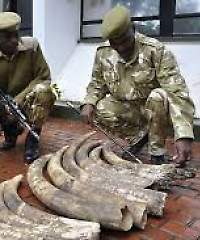 A United Nations recent report on organised crime has implicated Kenya and Tanzania as being the leading elephant slaughter houses in
the world, holding 70% of global ivory trade.
The bloody ivory from poached elephants is smuggled to China, Vietnam and other Asian countries through Dar es Salaam and Zanzibar in Tanzania and the port of Mombasa in Kenya, all accounting for two thirds of the global market ivory shipments.
In November 2012, Hong Kong authorities seized US$1.4 million worth of smuggled ivory in a container from Tanzania. The 569 tusks were found buried under hundreds of bags of sunflower seeds.
Corruption within security operatives and political spheres in both
Kenya and Tanzania is said to have been fuelling elephant poaching and
trade in bloody ivory.
In Tanzania, top politicians and leaders from the ruling Chama Cha
Mapinduzi (CCM) party have been implicated with trade in bloody ivory.
Conservationists blame CCM that has its grassroots leaders located in every corner of Tanzania, for collaboration with elephant poachers.
Khamis Kagasheki, Tanzania’s Minister for Natural Resources and Tourism, once said in Parliament that some politicians were involved in the bloody ivory trade.
“It is very unfortunate that this illicit business involves some rich people and politicians who have formed a very sophisticated network,” Kagasheki once said.
The United Nations report, coordinated and compiled by the UN Office on Drugs and Crime, warns the two East African nations over the killing of the elephants, saying the trend would jeorpadise regional tourism.
The report reveals that almost 70% of the bloody ivory consignments intercepted at different ports in the world during the past four years originated from East Africa, mostly Kenya and Tanzania; Tanzania stood the leading elephant slaughter house with 37% of confiscated bloody ivory, while Kenya held 27% of the seized ivory. Uganda counted just 3% of the ivory seizures.
The report had documented ivory confiscations originating from East Africa, saying bloody ivory seizures rose from 11 between 2000 and 2008 to 17 between 2009 to 2011, an indication that poaching of
tuskers was rising at an alarming pace.
Other African elephant keeping countries of West and Central Africa had a significant drop from 11 seized ivory consignments between 2000 and 2008 to three between 2009 and 2011, the UN report says.
“The African elephant is not currently deemed ‘endangered’ as a species, but its decimation in eastern Africa could be devastating.
Its loss could seriously undermine local tourist revenue, a key source of foreign exchange for many of the countries of the region,” UN says.
Tourism contributes the largest share of Kenya’s foreign earnings whereas it comes second in Tanzania after gold.
East Africa is home to the largest elephant population in Africa where more than 140,000 tuskers in eastern Africa are living today. This number constitutes about one-third of the African elephant population.
“An estimated 73 per cent of the elephants are located in Tanzania, and adding populations in Kenya, South Sudan, and Uganda would cover 99 per cent. These four countries are the source of most of the illicit ivory harvested in the continent,” the report says.
Conservationists estimate that 4%-11% of the elephant population in eastern Africa was killed in 2011; this would amount to 5,600-15,400 elephants which produced 56-154 metric tonnes of ivory originating in eastern Africa.
Tanzania’s biggest wildlife park, Selous Game Reserve, harbours the
largest population of elephants in East Africa with more than 50,000.
Ruaha, Katavi and Mkomazi National Parks in Tanzania had big
percentages of elephant poaching. Ruaha had recorded 94% and
Mkomazi 100% of the elephants killed by poachers during the
years mentioned in the UN report.
An eTurboNews article