

By Ogova Ondego
Published December 28, 2014
 Nairobi, Kenya’s commercial and political capital, has attractively alluring architecture dating to the British colonial days.
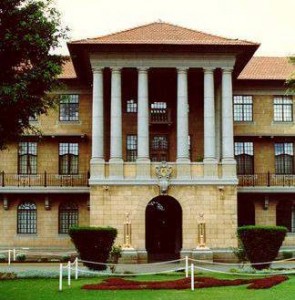
One of these landmarks is City Hall, an edifice built in 1934 that is today the seat of the Government of the County of Nairobi.
RELATED: Why Safety and Security should be stressed in Urban Planning
Another equally eye-arresting building is the one housing the headquarters of Kenya Railways. Situated on Haile Selassie Avenue in downtown Nairobi, this stately building was constructed in1930 at the peak of the railways transport business in East Africa.
 The foundation stone of the Anglican Church’s All Saints Cathedral on Kenyatta Avenue was laid by Sir Henry Conway Belfield, Governor of the British Kenya Colony, in 1917. Though 18 years away from completion, the building was made the Anglican cathedral of the highlands in 1924. It was consecrated in 1952, just a couple of years before Kenya attained independence in 1963.
RELATED: Nomad Turkana-Inspired Art Exhibition Comes to Nairobi National Museum
Kipande House, built in 1913, was originally constructed as a warehouse to serve the railway that the National Museums of Kenya (NMK), a state corporation whose responsibility is to collect, preserve, study, document and present Kenya’s heritage, says used to run along the present Uhuru Highway. The building was later used by the British colonial government as the registration centre for Africans who worked in colonial Nairobi.
“The term kipande,” NMK says, ” refers to an identification document with fingerprints and employment history compulsory for African males. The British Colonial Government enforced registration in 1919 to control the mobility of Africans who had to wear it around their necks. The kipande law was repealed in 1949.”
 Mc Millan Library was built in 1928 as a memorial to Sir Northup Mc Millan, an American philanthropist, hunter and traveller, by his widow, Lady Lucy. Till 1961 when it was handed over to the City Council of Nairobi, the library originally admitted Europeans only.
Kenya National Archives, built in 1931, was the first Bank of India building. Upon the bank’s merging with Grindlays Bank, the building was occupied by Kenya Commercial Bank before the Kenya government acquired it for the storage all government records and archives.
Originally an administrative building of the colonial government, the Pan Africa Life Assurance building on Kenyatta Avenue was formerly known as Agriculture House and was occupied by Teachers Service Commission.
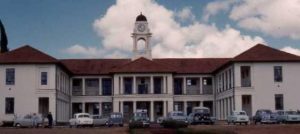 Built in 1929 for white settlers, Prince of Wales School that was renamed Nairobi School after Kenya attained independence from Britain in 1963, the school started admitting black boys in 1964 or 1966.
Government House, that is now known as State House, is another eye-pleasing colonial edifice.


